

Most conversations about construction robotics are about productivity. The stronger argument is safety, and it is a simpler one: the reliable way to prevent an injury is for nobody to be standing in the place where injuries happen. Confined spaces, fall zones, live edges, demolition faces, night inspections — these are tasks defined by where a person has to be. Technology that changes the “where” is doing something a toolbox talk cannot.
Start from the hierarchy of controls
Safety practice has a well-established order of preference: eliminate the hazard, substitute it, engineer it out, control it administratively, and only then rely on personal protective equipment. Most site safety effort concentrates on the bottom two rungs, because those are the ones a site team can act on unilaterally. Robotics is interesting precisely because it operates on the top three.
A machine that inspects a shaft is elimination. A rig that drills overhead is substitution. A sensor that stops a slew when a person enters the radius is an engineering control. That is a different order of intervention from another sign and another induction.
Where it is being used
Inspection in places people should not go
Confined spaces, deep shafts, tanks, voids, façades at height and post-blast or post-collapse faces. A crawler, a cabled robot or a drone with lighting and gas sensing goes first, and a person goes only if the data says they must. The permit-to-work process gets a set of readings before entry rather than at entry.
Perimeters, exclusion zones and proximity
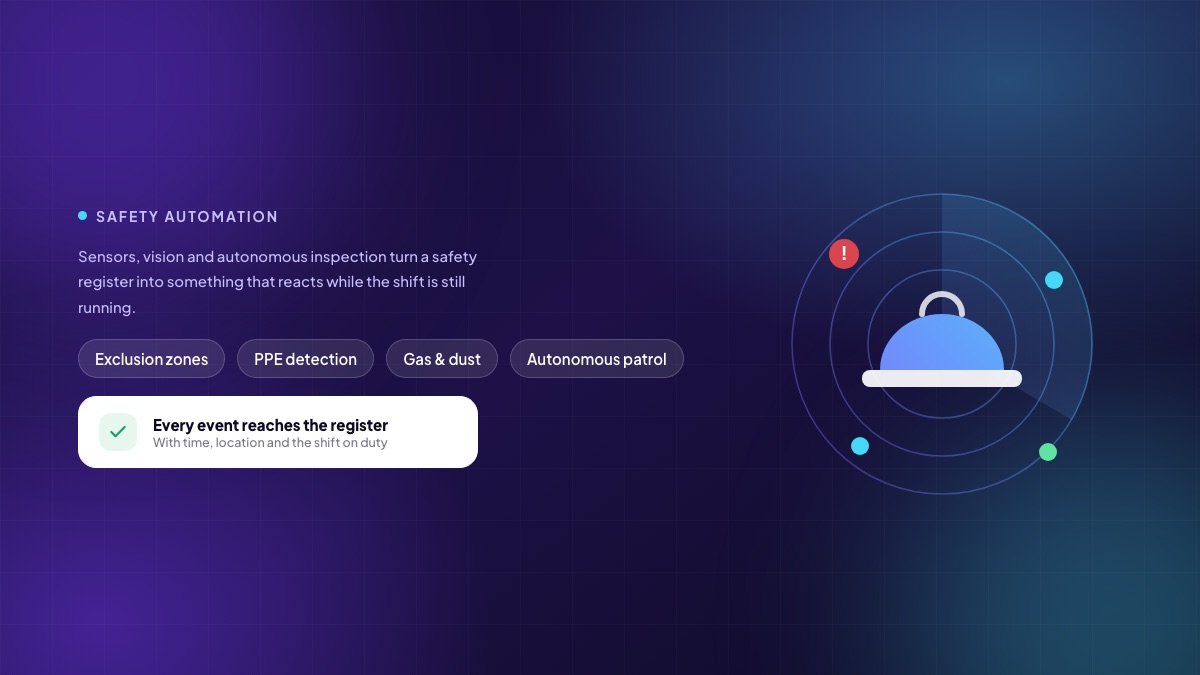
Struck-by remains one of the most consistent causes of serious site injury. Proximity systems put tags on people and sensors on plant so that a machine slows or stops when someone enters its envelope. Vision-based zone monitoring does the same for static hazards — open edges, lift shafts, excavations — and alerts before entry rather than after an incident.
Vision for PPE and behaviour
Cameras that detect a missing helmet, an absent harness at height or a person under a suspended load. The technology works; the implementation is where organisations succeed or fail. Used as a real-time nudge to a supervisor, it changes behaviour. Used as a surveillance record to punish individuals, it destroys the reporting culture that keeps a site safe, and people learn to avoid the cameras.
Environmental and structural monitoring
Continuous gas, dust, noise, temperature and vibration monitoring, plus tilt and movement sensors on excavation supports, scaffolds and adjacent structures. This is the category that most often catches something nobody was looking for, because it never stops watching and it does not get tired at 3 AM.
Autonomous patrol
Ground robots that walk a fixed route after hours, checking for open edges, missing barricades, spills, heat sources and unauthorised access. The point is not that a robot is better than a security guard. It is that it does exactly the same route, records exactly the same evidence, every single night.
The three ways these programmes fail
- Alert fatigue. A system that fires forty low-value alerts a day gets muted in a fortnight. Tune for the few events that would actually stop work, and route them to a named person.
- No closing of the loop. A detection that does not create an action with an owner and a due date is a log file. The value is in the corrective action, not the observation.
- Deploying it as a compliance camera. If the workforce believes the system exists to assign blame, near-miss reporting collapses, and near-miss reporting is the leading indicator that matters.
Why this is a records problem as much as a technology problem
Every one of these systems produces evidence: a reading, an image, a timestamp, a location, a shift. That evidence is worth very little sitting in a vendor portal and worth a great deal in your own safety register — linked to the project, the contractor, the work package and the corrective action raised.
Three practical consequences. First, incident investigation stops being reconstruction from memory. Second, you can see which contractor, which activity and which time of day your incidents cluster around, which is where prevention budget should actually go. Third, when a client, an insurer or an authority asks what controls were in place, the answer is a record rather than an assurance.
Where to start if you are starting
- List the tasks on your current projects where a person is exposed to a hazard that cannot be removed by sequencing. Be specific: not “working at height”, but “façade inspection on the east elevation at level 18”.
- For each, ask whether the person needs to be there or the information needs to be there. Only the second is a candidate for automation.
- Pick the one with the highest exposure and the clearest data need, and pilot it on one project.
- Wire the output into your safety register from day one, with an owner for every alert class.
- Measure near-miss reports, not just incidents. A programme that is working usually raises reported near misses before it lowers anything else.
The honest summary
Robotics will not make a badly run site safe. Sequencing, supervision, competence and the willingness to stop work still decide that. What it does is remove a category of exposure that no amount of supervision eliminates — the exposure created by needing a human being to physically occupy a dangerous place to find out what is going on there. That is a narrow claim, and it is a real one.
Written by the Teczen team. If you want to talk through how any of this applies to your projects, book a working session — no slides.