

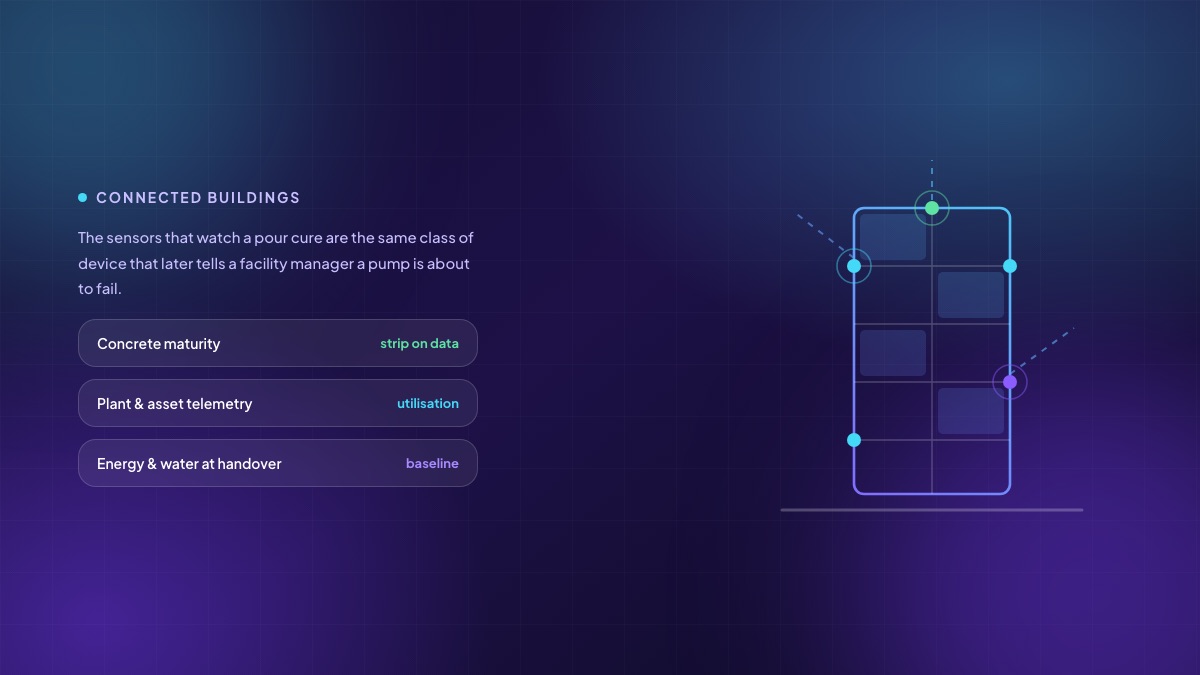
There is a sensor sitting in a concrete slab somewhere on your project reporting temperature every fifteen minutes. When the pour has cured, that sensor is discarded, along with everything it recorded. Two years later a facility manager will spend a fortnight trying to establish how the same building behaves. The technology is not the problem. Throwing the data away is.
On site: four things worth instrumenting
Concrete maturity
Embedded temperature sensors let you estimate in-place strength continuously rather than waiting on cube results. The practical consequence is a formwork stripping decision made on data instead of on a fixed number of days, which on a repetitive floor cycle compounds across the whole structure. It is also a safety control: the same data prevents stripping early on a cold week because the calendar said so.
Plant and asset telemetry
Hours run, fuel drawn, location, idle time. Most contractors discover two things in the first month: a meaningful share of running hours are idling, and at least one machine is not where the schedule says it is. Telemetry also converts maintenance from a calendar exercise into a usage-based one, which is where the saving is.
Environment and structure
Dust, noise, gas, temperature and humidity for worker health and for consent conditions; tilt, strain and vibration on excavation supports, scaffolds, cranes and adjacent structures. This category earns its place because it never stops watching. The alert that matters usually arrives at an hour when nobody is looking.
Access, materials and stores
Gate readers for who is on site, which is a safety and a payroll fact at the same time. Tags on high-value materials and formwork so the site store knows what actually arrived and what left. This is the least glamorous category and the one with the shortest payback on most projects.
After handover: the same devices, a different reader
A building that has been instrumented during construction arrives at handover with something rare: a baseline. Energy and water consumption in the first months of operation, HVAC behaviour under real occupancy, the actual performance of the plant that was specified. Every subsequent question — is this pump degrading, is this floor over-cooled, is the building performing as sold — is answerable against that baseline instead of against a design assumption.
For a developer who retains an asset or runs the facility management contract, this is the difference between reactive maintenance and planned intervention. For one who sells and exits, it is still worth having: performance data is what defence against a warranty claim looks like.
Where these programmes go wrong
- Fragmentation. Four vendors, four portals, four logins, no common view. The value of the second sensor type is only realised when it sits beside the first.
- Alert volume. A threshold set too tight produces noise, and noise gets muted. Tune to the handful of events that would actually change a decision.
- No owner. Every alert class needs a named person and an expected response. Without that, the dashboard is decoration and the incident still happens.
- Data that dies at handover. The contract with the contractor should say who owns the device data, in what format it is delivered, and that it transfers with the building.
- Security treated as an afterthought. Every one of these devices is a network endpoint. Default passwords, unsegmented networks and unpatched gateways are how a building management system becomes a liability.
The point that matters: readings need a home
A temperature curve is interesting. A temperature curve attached to a specific pour, on a specific floor, against a specific work package, with the stripping decision and the person who made it recorded next to it, is an operational record. The first is a chart; the second is evidence.
That is the practical test for any IoT proposal on a project. Ask where the reading ends up. If the answer is a vendor dashboard, you are renting a chart. If the answer is your own project record — linked to the activity, the contractor and the certification it supports — you are building an asset that keeps paying after the scaffolding comes down.
Starting small and honestly
- Pick the one decision on your current project that is currently made on a rule of thumb and would be better made on data. Formwork stripping is the usual answer.
- Instrument that decision only. One sensor type, one floor cycle, one named owner.
- Record the decision and the data together, in the project record, not in a spreadsheet.
- At the end of the cycle, ask whether the decision changed. If it did not, you have learned that your rule of thumb was sound — which is worth knowing and costs almost nothing to establish.
Written by the Teczen team. If you want to talk through how any of this applies to your projects, book a working session — no slides.